Business class glossary
The words airlines and agents use about a business class ticket, each explained in plain English, with what it means for your trip.
Routes and trips
How a trip is shaped: where it stops, where it connects and how it is ticketed.
- Open-jaw ticket
A round trip that flies into one city and home from another, or leaves from a different city than it returns to. It is priced as one ticket, not two one-ways.
- Multi-city ticket
One ticket with three or more flights between different cities, priced and issued together rather than as separate tickets.
- One-way ticket
A ticket for one direction only. On many international routes a business class one-way costs close to a round trip; some airlines price it at about half.
- Stopover
A planned stay of more than 24 hours in a connecting city on an international ticket, as opposed to a layover, which is a short wait between flights.
- Layover
The time between two flights in a connecting city, usually a few hours. On international tickets it lasts under 24 hours; anything longer is a stopover.
- Minimum connection time
The shortest time an airport and airline allow between two connecting flights on one ticket. Tickets are never sold with less.
- Nonstop and direct flights
A nonstop flight lands only at your destination. A direct flight keeps one flight number but may stop on the way, sometimes for hours.
- Red-eye flight
A flight that leaves late in the evening and lands early the next morning, so most of it is flown at night.
- Hub airport
An airport where an airline bases its network and connects most of its flights, such as Frankfurt for Lufthansa or Doha for Qatar Airways.
- Positioning flight
A separate flight to the city where the main trip starts, taken because a fare from there is cheaper or better.
- Fifth-freedom flight
A flight by an airline between two countries that are not its home, as part of a route that starts or ends at home.
Fares and rules
What sets the price of a ticket, and what happens if your plans change.
- Consolidator fare
A fare an airline sells through agencies at a negotiated price it does not publish on its own website, often below the published fare for the same seat.
- Published fare
The fare an airline files publicly and sells to anyone, on its own website and on booking sites: the price discounted fares are measured against.
- Fare class (booking class)
A one-letter code inside a cabin that sets a ticket's price and rules. Business class has several, often J, C, D, I and Z; each airline uses its own.
- Fare basis
The code on a ticket that names the exact fare it was sold at, starting with its fare class letter. It points to the fare's rules.
- Fare rules
The conditions attached to a fare: whether you can change or cancel, at what cost, the minimum and maximum stay, stopovers and open jaws.
- Refundable fare
A fare you can cancel for your money back, sometimes minus a fee. A nonrefundable fare returns nothing, or only a credit with the airline.
- Travel credit
Value an airline keeps for you when a ticket is canceled and not refunded in money, to spend on a later ticket within a set time.
- Schedule change
When the airline changes the time, flight number, route or aircraft of a flight you have booked, after you bought the ticket.
- Advance purchase
A fare rule that a ticket must be bought a set number of days before departure. Cheaper fares often require it.
- Carrier-imposed surcharge
A charge an airline adds to a ticket on top of the fare and government taxes, shown in the taxes box. It is the airline's own charge, not a tax.
- Upgrade
Moving from a lower cabin to a higher one, paid for or given by the airline to frequent flyers when the cabin has room.
Seats and cabins
What you get on board, from a flat bed to a door.
- Lie-flat seat
A business class seat that turns into a fully flat bed, 180 degrees, so you can sleep lying down on a night flight.
- Angled lie-flat seat
A seat that reclines to a long flat surface tilted at an angle, not level, so you tend to slide down it while sleeping.
- Direct aisle access
A seat layout where every business class seat opens onto the aisle, so no one climbs over a neighbor.
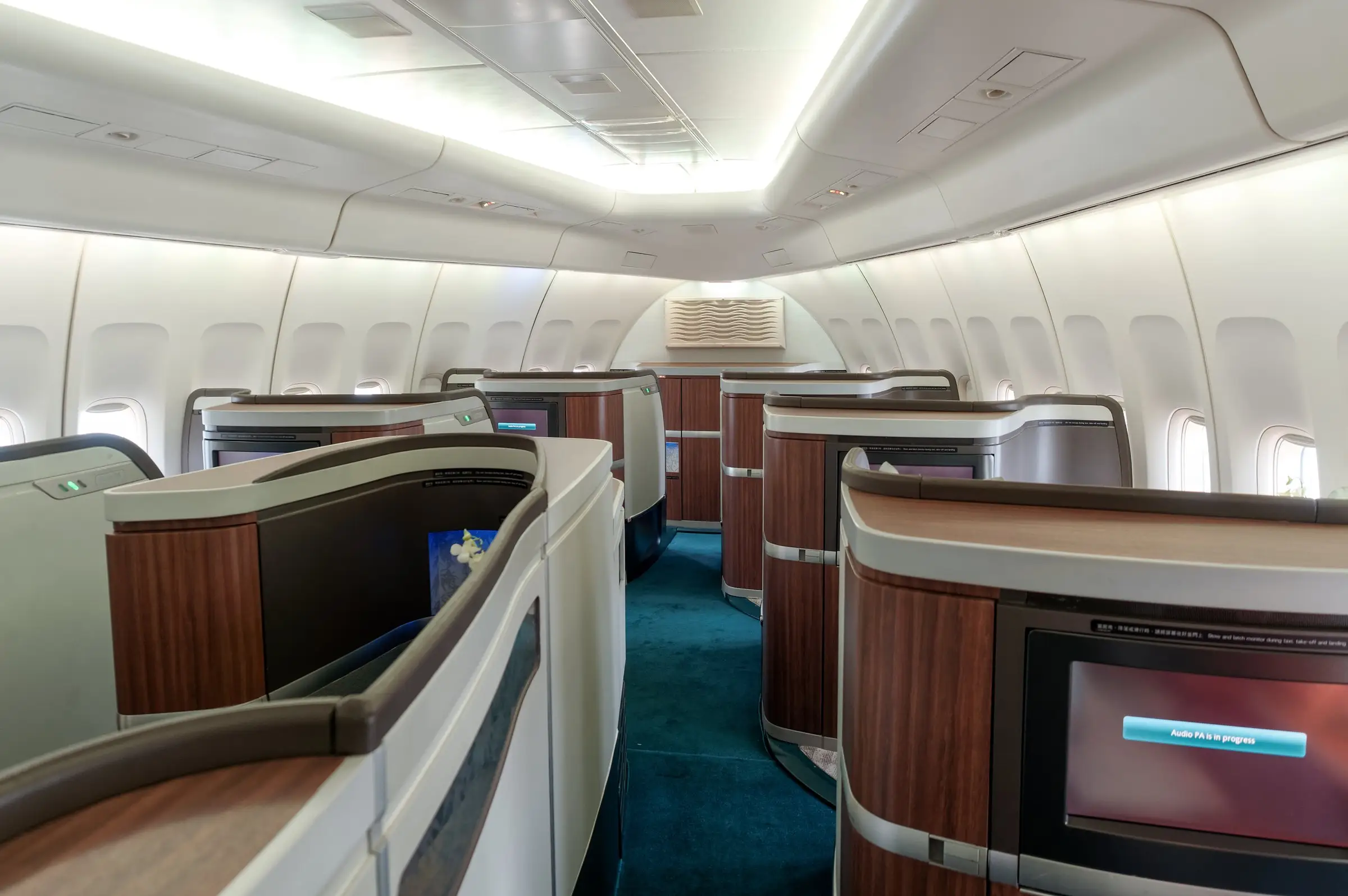
- Business class suite
A business class seat with a door or high walls that close it off from the aisle, for more privacy.
- Seat map
A drawing of the cabin that shows where each seat is and which are free. In business class it also shows the layout, such as 1-2-1.
- Widebody aircraft
A plane with two aisles, such as the Boeing 777 and 787 or the Airbus A350 and A380. Most long-haul business class cabins are on widebodies.
- Amenity kit
The small bag airlines give long-haul business class passengers: usually an eye mask, earplugs, socks, a dental kit and skin care.
- Premium economy
A cabin between economy and business class: a wider seat with more legroom and recline, but no bed.
- First class
The cabin above business class on some long-haul flights: fewer seats, more space and more service. Many airlines no longer offer it.
- Mixed-cabin itinerary
A trip that flies business class on some flights and economy or premium economy on others, priced as one ticket.
At the airport
From check-in to the gate: what a business class ticket opens before the flight, and what belongs to the traveler.
- Priority boarding
Boarding the plane in one of the first groups, before most passengers. Business class tickets include it.
- Fast track security
A separate, shorter security lane for premium passengers at many airports outside the US. In the US, TSA PreCheck is the usual faster lane.
- TSA PreCheck
A US program for faster airport security: approved travelers keep their shoes, belt and light jacket on and leave laptops and liquids in the bag.
- Global Entry
A US Customs and Border Protection program that speeds up immigration and customs when returning to the US. It includes TSA PreCheck.
- Lounge access
Use of an airline's lounge before a flight and between connections. Most international business class tickets include it, the airline's or a partner's.
- Chauffeur service
A car to or from the airport that a few airlines include with some business or first class tickets, in some cities; most airlines do not offer it.
Airlines and tickets
How airlines work together, and how to check and manage a booking.
- Airline alliance
A group of airlines that share networks, lounges and loyalty benefits: Star Alliance, oneworld and SkyTeam.
- Airline joint venture
A deeper partnership in which airlines coordinate schedules and fares on a set of routes and share the revenue, beyond an alliance.
- Codeshare flight
A flight sold under the flight number of more than one airline. One airline flies the plane; the others sell seats on it.
- Interline agreement
An agreement between airlines to carry each other's passengers and bags on one ticket, even outside an alliance.
- E-ticket number
The 13-digit number of an issued airline ticket. Its first three digits identify the airline, and it proves the ticket exists in the airline's system.
- Record locator (PNR)
The six-character code of a booking, also called a booking reference, confirmation code or PNR. You use it to manage the trip.
- IATA accreditation
Registration with the International Air Transport Association that lets an agency issue airline tickets. Each accredited agency has a number you can check.
- Baggage allowance
How many bags you can check and carry on, and how heavy they can be. Business class usually includes more than economy; the airline sets the exact allowance.
Questions about a fare? Ask an agent
An agent explains the rules of every fare before you pay, by phone, email or WhatsApp, 24/7.